A practical guide to checking backlinks
What a backlink actually does, how Google treats them in 2026, and how to read a backlink report without over- or under-reacting to the numbers.
What a backlink actually does
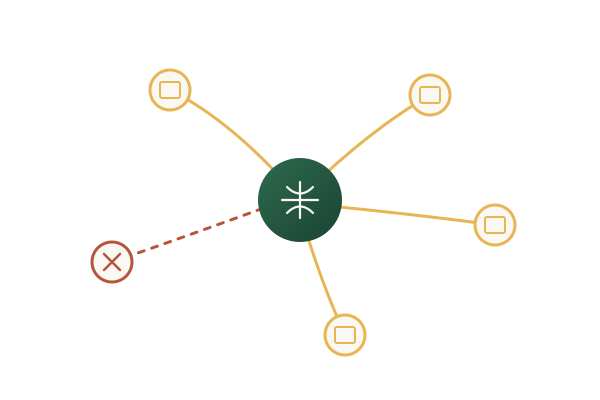
A backlink is simply another website linking to yours. What makes it useful for SEO isn't the link itself — it's what the link represents: one site's editors deciding your page was worth pointing readers toward. Google's ranking systems treat that decision as a signal of trust, and a page with many such signals from varied, reputable sources tends to rank better than an identical page with none. The mechanism behind this, PageRank, is decades old at this point, but the core idea hasn't changed — links are still, in effect, votes.
What has changed is how much scrutiny those votes get. A link that exists purely because it was paid for, traded, or generated in bulk doesn't carry the same weight as one that exists because someone genuinely found your content useful enough to reference. Google's systems are built specifically to tell the difference.
The numbers that actually matter
A backlink report hands you several counts, and it's easy to fixate on the biggest one. Here's what each actually tells you:
- Total backlinks — every link pointing at the domain, counted individually. A single page linking to you five times from its navigation counts as five here, which is why this number alone is the least reliable one to judge a site by.
- Referring domains — the number of distinct websites linking to you, regardless of how many links each one contains. This is the more honest measure of reach: ten links from ten different sites means far more than a hundred links from one.
- Domain rank — a relative authority score built from the link graph itself: who links to you, and who links to them. Useful for comparing two domains at a glance, though every provider calculates its own version, so a score only means something in comparison to another score from the same source.
- Broken backlinks — links pointing at pages on your site that no longer exist. Each one is essentially wasted trust: another site vouched for a specific page, and that vote now leads nowhere.
How Google treats links in 2026
Since September 2019, Google has treated nofollow, sponsored, and ugc link attributes as hints rather than absolute instructions — meaning a nofollow link isn't automatically worthless, but it also isn't a guaranteed source of ranking credit the way an unmarked editorial link is. The practical rule hasn't really changed since: paid or affiliate links should carry rel="sponsored", links inside forum posts or comments should carry rel="ugc", and genuine editorial links need neither.
Google's link-spam systems (SpamBrain and its successors) are specifically tuned to spot patterns rather than individual bad links — a sudden spike of dozens of new referring domains after months of nothing, clusters of sites that mostly link to each other, or exact-match commercial anchor text repeated across many links all read as manipulation attempts, even if any single link in isolation looks fine. A useful test: a link that would still make sense to have if search engines didn't exist is almost always safe. One that only exists to move a ranking is the one worth reconsidering.
Common mistakes when reading a backlink profile
- Treating total backlinks as the headline number. Referring domains is almost always the more meaningful figure — it can't be inflated by one site linking to you repeatedly.
- Panicking over a single low-quality link. Google's own guidance is clear that isolated spammy links pointing at a site are generally ignored rather than punished; disavowing is for patterns, not one-off nuisances.
- Ignoring broken backlinks. A broken backlink is often the easiest SEO win available — a redirect or restored page can recover value that's already been earned and is currently going nowhere.
- Comparing rank scores across tools. Every provider's authority score is calculated differently; a "40" from one source and a "40" from another aren't measuring the same thing.
What actually earns backlinks
Most legitimate backlinks trace back to one of a handful of sources: original data or research other people cite because it's easier than re-running the numbers themselves, a genuinely useful free tool that solves a specific problem, or writing detailed enough that it becomes the reference other writers point to instead of re-explaining the same thing. None of these require asking anyone for a link directly — they work because the content or tool gives someone a concrete reason to link that has nothing to do with SEO.
This is also why a thin backlink profile isn't always a sign of failure. A brand new site, or one in a narrow niche with few other publishers, will naturally have fewer referring domains than a broad consumer brand — comparing the two numbers directly says more about the market size than about either site's SEO work.
A simple checking routine
- Start with referring domains, not total backlinks — it's the number least likely to mislead you.
- Check broken backlinks next. Fixing these is usually faster than earning new links, and recovers value you already have.
- Use domain rank as a rough comparison point against competitors, not as an absolute score to chase upward on its own.
- Revisit the profile periodically rather than once. A backlink profile is a trailing indicator — it reflects link-building decisions made months earlier, and it's worth watching the trend, not just a single snapshot.
How this tool fits that routine
The check above returns exactly the four numbers this guide walks through — backlinks, referring domains, domain rank, and broken backlinks — sourced from a live, continuously-updated backlink index rather than a stale monthly snapshot. The free plan covers one domain check a day, enough to keep an eye on a single site's profile over time without needing an account for anything more casual than that. Premium raises that to a daily and monthly allowance sized for checking competitors alongside your own domain, without turning a quick check into an open-ended research project.
A backlink count is a fact about the past, not an instruction for what to do next — deciding whether a link is worth chasing, or a broken one worth fixing, is still a judgment call this tool can inform but not make for you.