A practical guide to trending keyword research
What "trending" actually measures, how to tell a real trend from noise, and how to use rising demand without publishing content that ages badly.
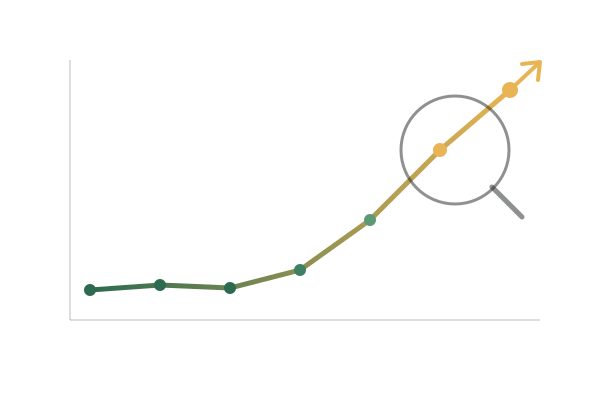
What "trending" actually means
A trending keyword isn't simply a popular one — it's a term whose search volume is rising relative to its own recent history. A keyword with 50,000 monthly searches that's held steady for two years isn't trending; a keyword that jumped from 200 to 900 searches this month is, even though its total volume is far smaller. The two numbers answer different questions: total volume tells you how big the audience already is, and the trend tells you whether that audience is growing right now. Content built around a genuinely rising term gets a real head start — less existing competition, and an audience whose interest hasn't been fully served yet by everyone else's content.
Reading a trend signal without being misled by it
A single month's spike is not automatically meaningful. Search interest is naturally seasonal — gift-related terms trend every December, tax terms every spring, and plenty of niche topics have their own predictable annual bump. The useful question isn't just "is this month higher than average," it's "is this rise part of a repeating pattern, or something new." A category browse that looks at the broader pattern, not a single snapshot, is what actually separates the two.
It's also worth treating very low absolute volume with some caution. A term that moved from 10 searches to 40 is technically a 300% increase, but the underlying audience is still tiny — the percentage alone can make a genuinely minor blip look dramatic. Pairing the trend percentage with the actual volume number, rather than reading either one alone, gives a much more honest picture of whether a term is worth building content around.
Google's stance on trend-chasing content
Google's own guidance on what counts as unhelpful content specifically calls out material "created primarily to capitalize on trending search queries" rather than to genuinely inform the reader. The distinction that matters is intent and depth, not timing — writing about a rising topic isn't the problem; writing something thin and rushed purely because the topic is rising is. The same standard that applies to any other content applies here: does this page teach the reader something they didn't already know, written by someone who actually understands the subject, or does it exist mainly to catch a temporary spike in search traffic. A trending keyword is a reason to write about a topic sooner, not a reason to write about it worse.
Common mistakes when working with trending data
- Confusing a seasonal cycle with a genuine trend. Check whether the same rise happened around the same time last year before treating it as new momentum.
- Chasing percentage change on tiny volume. A 400% jump from 5 to 25 searches is still 25 searches — worth noting, not worth building a content calendar around on its own.
- Publishing thin content to move fast. A rushed 300-word page rarely outranks an existing, thorough one just because it was published first — being early only helps when the content underneath is genuinely good.
- Ignoring CPC as a signal. A rising keyword with meaningful CPC suggests advertisers are already reacting to the same demand — a useful second confirmation that the trend has commercial weight, not just curiosity traffic.
- Treating every category the same way. Fast-moving categories (electronics, entertainment) naturally show sharper trend swings than stable ones (furniture, hardware) — a 30% move in a volatile category means less than the same 30% move somewhere that rarely shifts at all.
A simple research routine
- Start from the product or service category closest to what you actually write about — a broad category surfaces far more candidates than guessing individual seed terms.
- Sort by trend, not raw volume, so the terms gaining momentum right now surface first instead of being buried under already-saturated head terms.
- Cross-check the shortlist against volume and CPC together — a strong trend with reasonable volume and non-trivial CPC is the combination actually worth prioritizing.
- Write something genuinely useful about it, at the same quality bar as anything else on the site — the trend earns you a timing advantage, not a quality exemption.
- Revisit the category periodically. A list that was accurate this month drifts as the underlying trend either keeps climbing or fades back down.
Why this sits on Premium
Unlike a single keyword search, a category-wide trend search asks our data provider for dozens of keywords at once, each carrying the underlying search history needed to compute a genuine trend — that's a meaningfully larger request than checking one term. Keeping it on Premium, with a daily and monthly cap like the rest of the paid features, is what makes it possible to offer a real, calculated trend score rather than a rough estimate, without the cost of that data working against the free tier that everyone else relies on.
How Trending Keywords fits that routine
The category dropdown here pulls directly from Google's own live topic taxonomy — a broad set of content categories, not a fixed list that goes stale. Every result is sorted by a trend percentage measuring genuinely rising recent interest, so the terms at the top of the table are the ones actually gaining ground right now, not simply the biggest terms in the category. Search volume and CPC sit right next to the trend figure for the same reason the guide above recommends checking them together — so a promising trend and a hollow one are easy to tell apart at a glance, across any of the countries covered by this tool.
A rising number is a signal worth acting on, not a guarantee — whether a trending term actually fits your audience, and how thoroughly you cover it, is still the part that determines whether the head start turns into anything.